Executive summary
FurnaSure is a white-coated ceramic foam insulation product for furnace users and furnace makers who need more than commodity insulating firebrick.
It is built for 600 °C to 1290 °C furnace applications and stays stable from cryogenic −200 °C upward. Its value is not only in reaching temperature, but in building a lighter, cleaner, faster-responding furnace around a useful work zone.
Typical properties include very low density (approximately 0.15–0.20 g/cc); low thermal conductivity (approximately 0.05 W/m·K); a white, lower-shedding coating; high electrical insulation; easy machining; strong bonding with common furnace cements; severe thermal-shock tolerance (~1000 °C/sec demonstrated); and cryogenic stability down to liquid-nitrogen temperatures.
The compact furnace advantage
K23 insulating firebrick is a familiar, economical benchmark. FurnaSure is not trying to replace K23 everywhere. Its best use is where the oven builder cares about the whole system: shell size, door weight, heat-up time, cool-down time, removable liners, custom shapes, and clean handling.
The simplest way to see the difference is to compare a one-cubic-foot active hot zone. In the illustrative build below, a 12 in. × 12 in. × 12 in. chamber is insulated either with 4.5 inches of representative K23 or with 1.0 inch of FurnaSure. The two wall packs have roughly comparable conductive thermal resistance, but the FurnaSure build uses far less insulation volume and stores far less heat.
| Design item | K23 IFB build | FurnaSure build |
|---|---|---|
| Active hot zone | 1.0 ft³ cube · 12 in.³ | 1.0 ft³ cube · 12 in.³ |
| Wall thickness | 4.5 in. | 1.0 in. |
| Conductive resistance | 0.48 m²·K/W | 0.51 m²·K/W~7% higher |
| Outer envelope | 21 in. cube · 5.36 ft³ | 14 in. cube · 1.59 ft³ |
| Insulation volume | 4.36 ft³ | 0.59 ft³~86% less |
| Insulation weight | ~140 lb | ~7 lb~95% less |
| Stored heat to 1100°C | ~68 MJ | ~2.7 MJ~25× less |
| Heat-up burden at 3 kW | ~6.3 hours | ~15 minutes |
| Cycle implication | High thermal inertia; often slowed by the brick package | Low thermal inertia; driven more by load, controls & process |
In practical terms, FurnaSure lets a furnace maker trade “more brick” for a smaller and lighter thermal package. A compact one-cubic-foot FurnaSure-lined oven could have a far smaller outside box and a dramatically lighter door, roof, plug, or removable liner. It also has much less heat stored in the insulation, so ramp-up and cool-down can be much less dominated by the furnace walls. The exact cycle-time benefit depends on the heating elements, load mass, controller, airflow, shell design, and allowable thermal gradients, but the design direction is clear: less dead thermal mass means a more responsive furnace.
Machinability, bonding & custom geometry
FurnaSure can be machined in its final fired state. Standard saws, drills, CNC tools, lathes, and hand tools can be used with appropriate dust protection. The material holds sharp edges unusually well for a highly insulating ceramic foam, so small holes, curved cutouts, element clearances, thermocouple ports, gas passages, interlocks, and replacement liners can be made from customer drawings or CAD files.
FurnaSure also bonds well with a wide range of normal high-temperature oven cements and refractory cements when the joint is properly designed and applied. That makes it practical to build larger assemblies from machinable blocks and panels: door plugs, baffles, covers, liners, sample nests, spacers, and low-load furnace furniture.
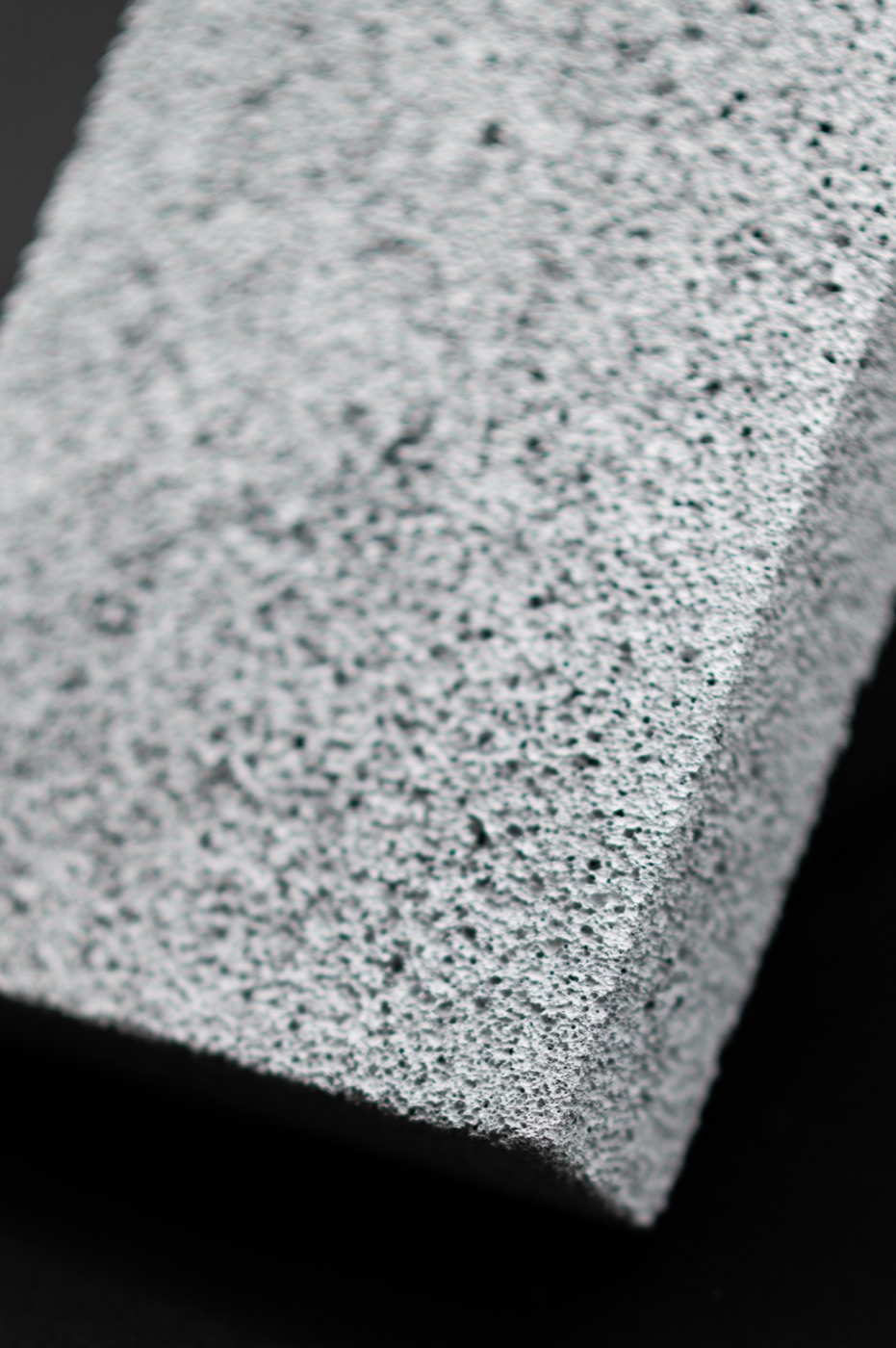
This is a meaningful distinction from very high-end friable boards and specialty refractory insulation materials that can be expensive, dusty, brittle, and hard to machine cleanly. FurnaSure is more expensive than K23-type IFB, but it is intended to be much less expensive and easier to fabricate than premium zirconia/silica-style refractories in many custom furnace applications.
Thermal-shock tolerance & induction furnaces
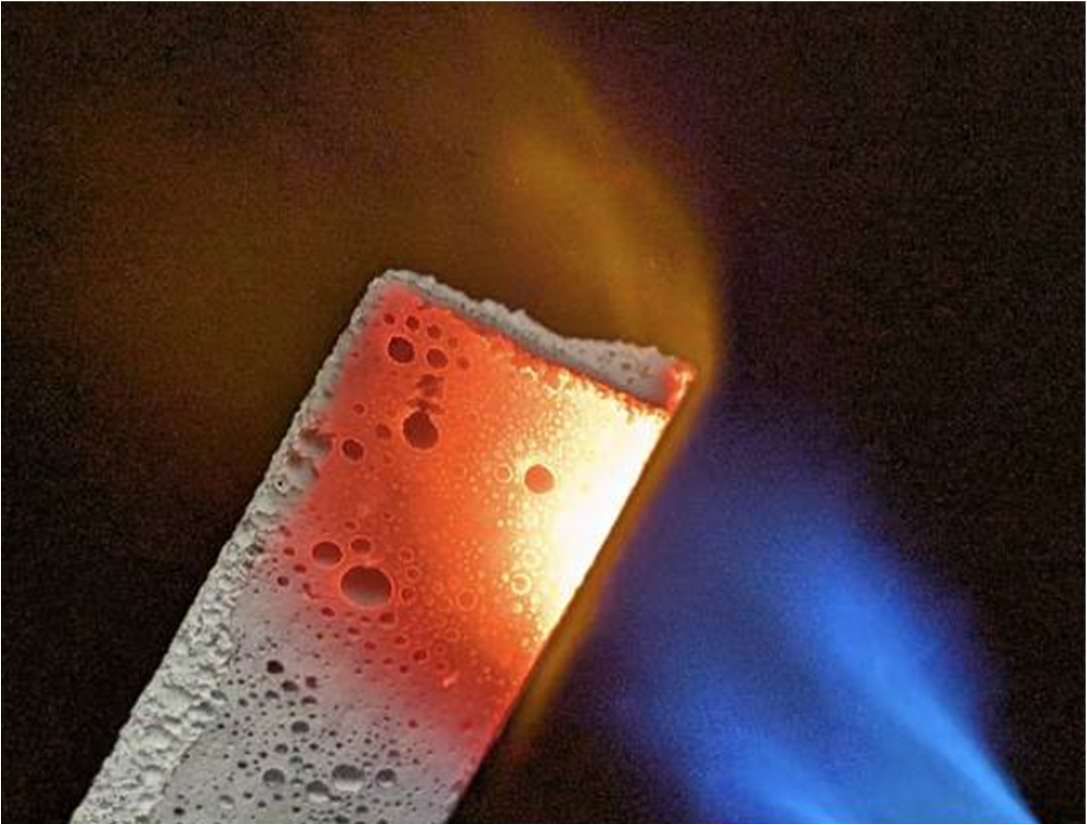
FurnaSure is not only a low-mass insulator; it is a shock-tolerant one. The material can withstand temperature shocks of approximately 1000 °C per second, helping it tolerate rapid heat-up, cold-to-hot transitions, and localized thermal gradients that would be risky for many rigid ceramics and friable insulation boards.
That matters in induction furnaces, where the workpiece, susceptor, or local fixture can heat much faster than the surrounding insulation. A material that survives fast, uneven heating gives designers more freedom to place insulation close to the hot work and use tighter, more useful geometry.
Clean, stable, electrically insulating hardware
FurnaSure is designed as a chemically stable, electrically insulating ceramic foam for long-duration service up to 1290 °C in appropriate furnace environments. The white coating provides a cleaner working surface than exposed black foam and helps users visually inspect the part for contamination, handling damage, or process residue. The material is also highly electrically insulating, so it is not expected to short, shield, or electrically interact with resistance heating elements when installed with proper clearances and standard furnace-design practice.
It is also stable down to liquid-nitrogen temperatures, making it useful where parts see cryogenic handling, cold-side exposure, or large temperature swings before returning to heat. It is ready to use from −200 °C to 1290 °C.
Best-fit applications include furnace liners, door plugs, access panels, removable insulation inserts, tube-furnace plugs, baffles, low-load shelves and setters, sample holders, spacer blocks, covers, and custom fixtures where low mass, insulation, cleanliness, and machinability matter more than high structural load bearing.
Suggested customer evaluation path
The fastest evaluation is to try FurnaSure in one removable part of the furnace: a door plug, observation-port block, sidewall insert, baffle, cover, or sample fixture. Useful measurements include outside shell temperature, heat-up time, cool-down time, energy per cycle, temperature uniformity, visible shedding, cement-bond integrity, dimensional stability, and handling durability after repeated cycles.
Conclusion
FurnaSure gives furnace users and furnace makers a design option between commodity insulating firebrick and very expensive specialty refractory boards. Its combination of low density, low thermal conductivity, machinability, cement bonding, white coated surface, chemical stability, and electrical insulation makes it a compelling material for compact, clean, custom, high-temperature furnace systems up to 1290 °C.
Calculation note
Comparison is a design-screening model, not a furnace warranty. Assumptions include a cubic 1 ft³ active zone; representative K23 thermal conductivity of 0.24 W/m·K at 1100°C and density of 0.513 g/cc; FurnaSure thermal conductivity of 0.05 W/m·K and representative density of 0.18 g/cc; specific heat of 1.0 kJ/kg·K for K23 and 0.85 kJ/kg·K for FurnaSure. Final suitability must be validated in the customer’s furnace, atmosphere, duty cycle, and acceptance framework.