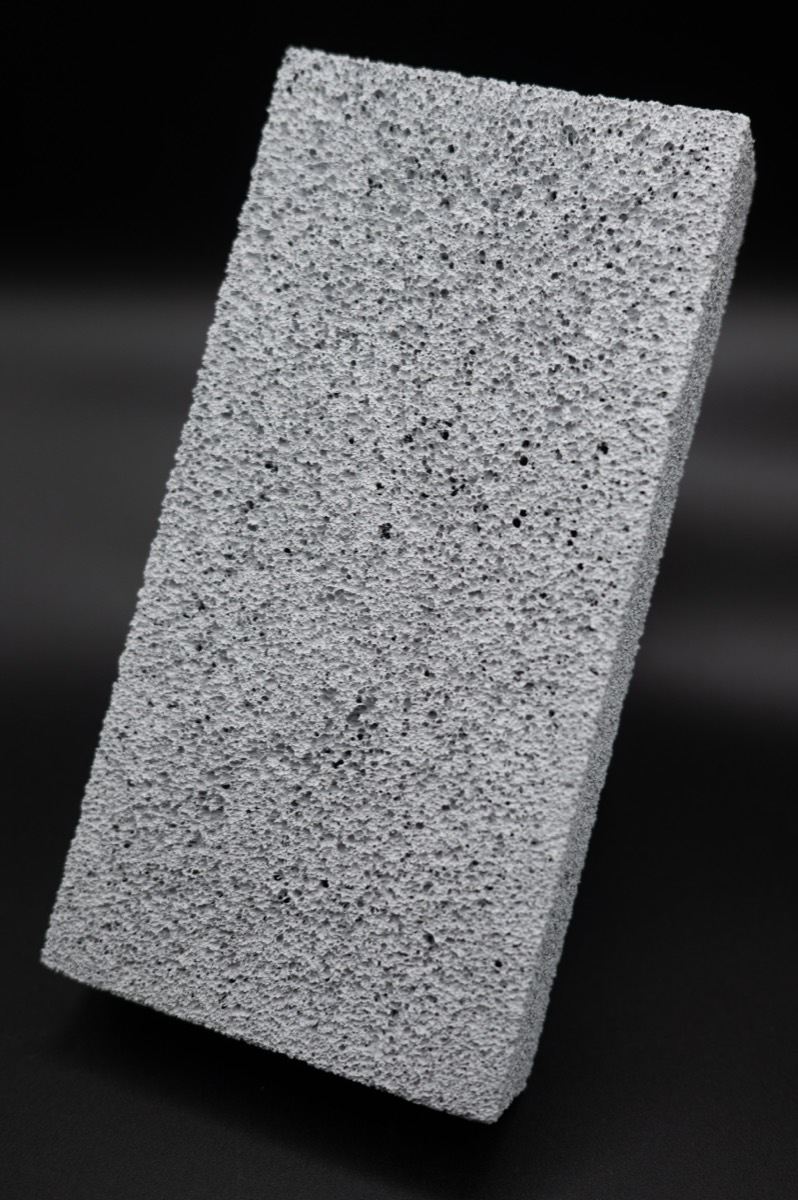
FurnaSure™ is a white-coated ceramic foam insulation for compact 1290 °C furnace systems. It machines cleanly, bonds with common furnace cements, and is electrically insulating, letting furnace makers trade heavy firebrick for a lighter, faster-responding thermal package.
K23 insulating firebrick is cheap but heavy and slow. Specialty zirconia/silica boards perform but are costly, dusty and brittle. FurnaSure is the option in the middle, made for compact, clean, custom furnaces.

Economical and familiar, but high thermal mass, thick walls and heavy assemblies slow every cycle.
Low density, low conductivity, machinable and cement-bondable. Firebrick-level resistance in a fraction of the mass.
High performance, but expensive, often friable, dusty and hard to machine cleanly.
Shell size, door weight, heat-up time, custom shapes, clean handling. FurnaSure is built for makers who care about all of it.
Firebrick-level resistance in ~1 inch instead of 4.5. Up to ~86% less insulation volume and ~95% less weight for a 1 ft³ hot zone.
Far less dead thermal mass means ramp-up and cool-down aren't dominated by the walls. Roughly 25× less stored heat than a brick package, so you can push higher ramp rates and throughput.
Withstands ~1000 °C/sec thermal shock, a natural fit for induction furnaces, where the workpiece or susceptor heats far faster than the insulation around it.
Stable down to liquid-nitrogen temperatures. Ready to use from −200 °C to 1290 °C for cold-side exposure and large temperature swings.
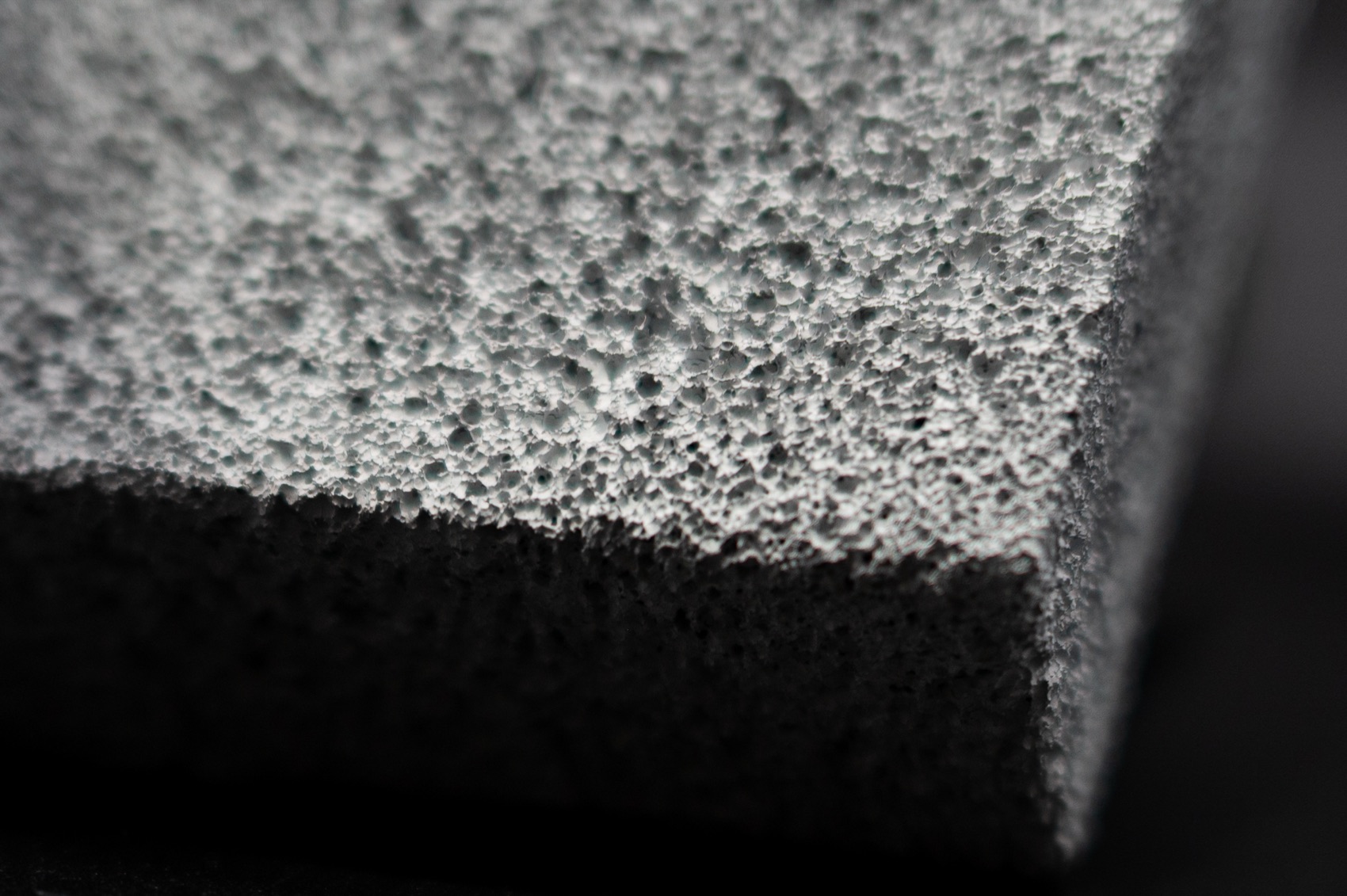
Cut in its final fired state on standard saws, drills, CNC and lathes. It holds sharp edges, so element clearances, ports, gas passages and liners come straight from your CAD.
Bonds well with common high-temperature furnace cements, so blocks and panels assemble into door plugs, baffles, covers, liners and low-load furniture.
A white coating sheds less than exposed black foam and makes contamination, handling damage and process residue easy to inspect at a glance.
Highly electrically insulating and chemically stable for long-duration service to 1290 °C. At proper clearances it won't short or shield resistance elements.

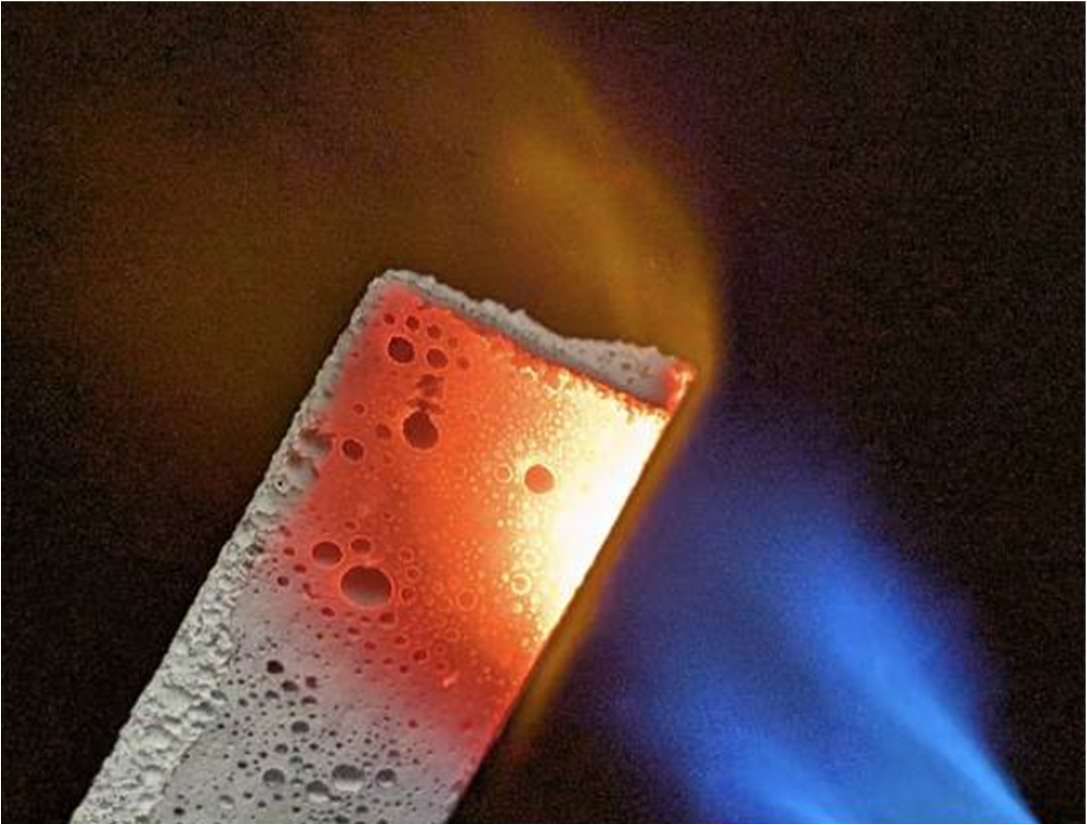
A direct flame drives one side glowing red while the opposite face stays cool enough to hold. That is ~0.05 W/m·K conductivity and ~1000 °C/sec shock tolerance at work. The same behavior lets FurnaSure sit close to the hot work in induction and fast-cycling furnaces.
Insulate the same 12 × 12 × 12 in. hot zone with 4.5 in. of K23 firebrick or 1.0 in. of FurnaSure. The conductive resistance is comparable. Everything else isn’t.
| Design item | K23 IFB build | FurnaSure build |
|---|---|---|
| Wall thickness | 4.5 in. | 1.0 in. |
| Conductive resistance | 0.48 m²·K/W | 0.51 m²·K/W~7% higher |
| Outer envelope | 21 in. cube · 5.36 ft³ | 14 in. cube · 1.59 ft³ |
| Insulation volume | 4.36 ft³ | 0.59 ft³~86% less |
| Insulation weight | ~140 lb | ~7 lb~95% less |
| Stored heat to 1100°C | ~68 MJ | ~2.7 MJ~25× less |
| Heat-up burden at 3 kW | ~6.3 hours | ~15 minutes |
| Cycle implication | High thermal inertia; slowed by the brick | Low inertia; driven by load & controls |
Design-screening model, not a furnace warranty. Assumes a 1 ft³ cubic active zone; representative K23 at 0.24 W/m·K and 0.513 g/cc; FurnaSure at 0.05 W/m·K and 0.18 g/cc. Actual cycle benefit depends on elements, load, controls and shell design. Read the full white paper →
Rated from cryogenic −200 °C up to 1290 °C in air, with tunable porosity and severe thermal-shock tolerance. Values are typical guidance, subject to manufacturing variation.

| Parameter | FurnaSure (SI) | FurnaSure (Imperial) |
|---|---|---|
| Density | 0.15–0.20 g/cc | 9.4–12.5 lb/ft³ |
| Max operating temperature in air | 1290 °C | 2350 °F |
| Thermal conductivity | ~0.05 W/m·K | ~0.029 BTU/h·ft·°F |
| Specific heat capacity (25 °C) | 850 J/kg·K | 0.20 BTU/lb·°F |
| Heat capacity per volume | ~0.13–0.17 MJ/m³·K | ~1.9–2.5 BTU/ft³·°F |
| Coefficient of thermal expansion | 3.2 × 10⁻⁶ /°C | 1.8 × 10⁻⁶ /°F |
| Compressive strength | 2–14 MPa | 300–2000 psi |
| Pore size (tunable) | 80–1200 µm | 3–50 mils |
| Pore density (tunable) | ~12–100 pores/cm | 30–250 PPI |
| Machinability | Easy | Easy |
| Thermal-shock tolerance | ~1000 °C/sec demonstrated | ~1800 °F/sec demonstrated |
| Low-temperature stability | −200 °C (LN₂) | −320 °F (LN₂) |
| Electrical behavior | Highly electrically insulating | Highly electrically insulating |
Standard stock
9″ × 4.5″ × 1.25″ (half fire brick) and 9″ × 4.5″ × 2.5″ (full fire brick).
On request
Panels up to 2″ thick and 12″ × 12″ area, smaller furnace-furniture shapes, and cemented assemblies in any high-temperature cement for custom geometry.
Typical values are guidance only and subject to manufacturing variation. Validate final suitability in the user’s furnace, atmosphere, duty cycle, and acceptance framework.
Anywhere cleanliness, insulation, light weight and machinability matter more than heavy structural load-bearing, from induction furnaces to cryogenic systems.
The fastest way to evaluate FurnaSure is one swappable component: a door plug, port block, sidewall insert, baffle or sample fixture. Then measure what changes.
Choose one removable element of your furnace to swap to FurnaSure.
Shell temperature, heat-up and cool-down time, energy per cycle, uniformity, shedding and bond integrity.
Check dimensional stability and handling durability after repeated cycles, then scale up.
Tell us the service temperature, the part you’d like to build, and your geometry. We’ll recommend an approach and ship a sample or a machined test piece.